“Soft Skills” have become one of most used buzz words of the 21st century. However, if you ask people to define soft skills, they are likely to give you similar but vague definitions.
- Wikipedia defines soft skills as “associated with a person’s ‘EQ’ (Emotional Intelligence Quotient), the cluster of personality traits, social graces, communication, language, personal habits, friendliness, and optimism that characterize relationships with other people.”
- MindTools defines soft skills as “your work ethic, your attitude, your communication skills, your emotional intelligence and a whole host of other personal attributes”
What we are missing is a clear framework to help us define and distinguish what are soft skills. This is why I created the “Career Success” Framework below. 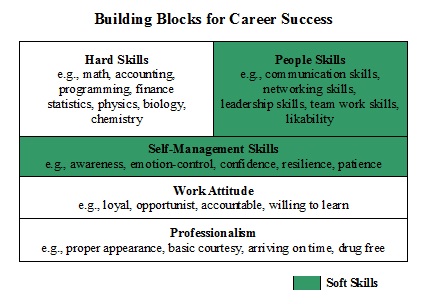 There are five categories of job skills essential to our career success, two of which are soft skills categories.
- Hard skills – These are trade skills and subject matter expertise, like programming, accounting, financial analysis, or chemical engineering that we need to perform our job.
- Soft Skills – People skills – These are the skills we use to interact with others at work. Examples of people skills include communications and interpersonal skills as well as skills to manage upwards and deal with office politics. For example,
- It’s not enough to have a brilliant idea, it is only when we communicate it effectively and to the right people, can we garner the support needed to implement it.
- It is not enough to work hard. If no one knows about it, it unfortunately doesn’t count. We have to subtly self-promote, so that the right people can appreciate all of our hard skills and soft skills.
There are 18 people skills that we should hone and develop over the course of our career. Mastering these people skills will enable us to engage, influence, and earn the support of others.
- Soft Skills – Self management skills – These are the skills to help us manage self perception and our reactions to adverse situations. For examples,
- How can we succeed if we don’t feel confident to take certain actions?
- How can we succeed if we cannot control our angry response to unexpected situations?
There are 10 self management soft skills including confidence, patience and stress management, which are fundamental to our career success.
- Work Attitude – This category refer to our temperament and outlook. For example, work ethic, positivity, and willingness to learn are attributes typically valued by companies.
- Professionalism – This category includes basic business etiquette – the way we dress, speak, and behave in a work setting.
I hope this definition of soft skills provides a clear picture of what they are and how they are different from the other categories. Now, find out more about why soft skills are critical to your workplace success.
Interested in Learning More?
Subscribe to our free Newsletter – How to Succeed like an Executive.
yes we need those soft skills for a new job. I too myself will be starting a new job soon, so this is helpful, it good to learn new material. and thank you.
Carol
All of the soft skills are required to be successful in your career. The hard skill make take time to master but the other skills can practice with friends and relatives. Use them as your testing ground for feedback on what works or does not.
Claire- would need to work on neverous by joining a network group. Being nervous may be seen as a weakness, a good report with your boss, coworkers and subordinates is important to work as a team. Without a good rapport, your co- workers may not want to work with you on your team
Hello Everyone,
I choose to start with optimism, friendly,fast learner, time management skills througho. I could go on and on but I think this discussion is ment to share our individual choices of soft skills and get the conversation moving. I am out of my hometown to see a special doctor tomorrow. So this post comes from my cellphone and the layout is weird so this is the best I can do for today. I hope my list of soft skills is inspiring to all. And dont forget confidence
Wonderfully described !!
Soft skills starts right from communication and involving best in a team. Moreover, being flexible and adjustable also remarks these characteristics.
Marge,
Soft skills do start at communication, as with life and business, if you don’t communicate your goals and objectives, you will not reach your goals.
The information provided in the website is quite inspiring and informative. In faact, it kindled my interest further in Soft Skills.
Thanks. Glad to help it’s helpful. Am still investigating how to help readers to the next level – take action to practice soft skills on baby step at a time. stay tuned 🙂
Dear Ms. Han,
I love your work. It helped me tremendously in putting a PP together for work. I’ll make sure to cite your work and give you full credit. You’re insight is just wonderful, precise and to the point. Thank you for your research here! 🙂
Ananda, thank you for your comment and support. I am so glad to hear they are helpful. Let me know if you have questions. Constantly trying to make this better. Best wishes
we need to use helpful source
Dear Ms.Lie,
I read your web,
its good job for mankind,
i like these all subjects, points, research, simple, easy to understanding & useful too.
actually life is limited and knowledge are unlimited.
therefore Human, Human’s Body, Brain, Emotions knowledge are needful.
and
Hats Off Mam
Thanking You
Muhammad Shabbir Qadri
Surat, India
Glad to hear this is helpful. Best wishes
Clear n crisp…..till date the most described and decorated definition provided…looking forward for more info to master this profound subject called “soft skills”….