I’ve cried three times a week this past month — and not because I was sad. The tears came from something deeper: the painful realization of how brutal my inner critic has been for years. Not a gentle voice encouraging growth, but a harsh one constantly telling me I am behind, lacking, or still not enough.
I didn’t fully see it until I started the Connection Course by Joe Hudson. The course explores how we relate to ourselves, how we judge others, and how we connect more honestly with others. It has been emotional, uncomfortable, and incredibly revealing.
This article isn’t really about the course. It’s about what happened when I finally named my inner critic, shared it with people I trust, and realized that speaking it out loud made it weaker.
If you’ve ever wondered how to overcome your inner critic, this is what I’m learning.
What Is an Inner Critic?
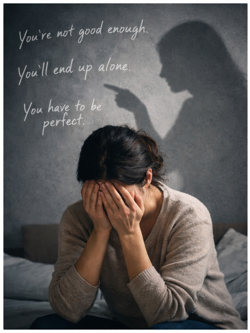 Your inner critic is the negative voice inside your head that judges, shames, compares, and tells you that you are not enough.
Sometimes it sounds like motivation. Sometimes it sounds like protection. But often it is just an old fear repeating itself.
Many of us don’t even realize how much our inner critic shapes our choices, relationships, confidence, and willingness to try new things.
What My Inner Critic Sounds Like
When I listened closely, I realized my inner critic wasn’t random. It repeated a few familiar stories that had been running in the background for years.
1. “You’re Not Good Enough Yet”
That word yet keeps moving the finish line.
It tells me that no matter what I’ve accomplished, worthiness is still somewhere in the future. I’ll be loved when I achieve more. I’ll feel secure when I prove myself again. I’ll finally relax once I become more impressive.
That kind of thinking may look like ambition, but internally it feels exhausting. It creates a life where success is never enough because the standard always changes.
The truth is, I have already achieved more than I once dreamed possible. But without questioning this voice, I can still feel like something essential is missing.
2. “You’ll End Up Alone”
This story runs deeper than achievement. I’m an only child, and when I first moved to the United States, some early friendships felt painful and unstable. For many years, relationships felt uncertain because I moved every four to five years until I was 29 years old.
During that time, I struggled to build lasting friendships. Some of the people I trusted or thought I could lean on ended up ignoring me or even ridiculing me. Instead of seeing that as circumstance — or recognizing they simply were not the right people for me — I blamed myself. I wondered if I was hard to be friends with. I told myself I needed to be careful. I feared I might end up alone.
That story may have helped me navigate difficult seasons of life, but it no longer reflects reality. Today I have a loving husband and meaningful friendships. I may not have a huge circle, but I have real people in my life — the kind who show up when it matters.
The story is old. My life is not.
3. “If You Try Something New, You Must Be Good at It Immediately”
This one may be the most limiting belief of all. If I believe I must be good at everything right away, how could I ever take risks? How could I be a beginner? How could I try something joyful, awkward, messy, or uncertain?
When I looked deeper, I could see where this story came from. As a child, if I didn’t immediately excel at something, my dad would lecture me on what I could do better. He meant to help. He was trying, in his own way, to guide me toward improvement.
But as a child, that’s not how it landed. I felt embarrassed. I felt smaller. I felt less worthy when I wasn’t instantly good. My father did not intend to create that wound. But I turned those moments into a lifelong rule: if you are not naturally good at something, you are failing.
That rule doesn’t serve me anymore.
Why Sharing My Inner Critic Changed Everything
For years, these beliefs lived quietly in the background. They influenced my choices, increased self-doubt, and made me feel like I was constantly chasing some future version of myself. Unspoken thoughts often feel like facts. Once spoken, they become something we can examine.
When I shared these stories with trusted friends, I expected embarrassment. Instead, I was met with empathy. They understood. They had their own inner critic too.
That mattered more than I expected. The shame began to soften. The beliefs started to look less like truth and more like old survival strategies I had never updated.
How to Overcome Your Inner Critic
If this resonates, here are a few ways to begin.
1. Notice the Voice
Pay attention when you feel anxious, ashamed, jealous, defensive, or not enough.
Ask yourself: What am I saying to myself right now?
Write it down exactly as it sounds. Do this everyday for five days
2. Find the Pattern
Most inner critics repeat a handful of stories:
- I’m behind
- I’m not enough
- I’ll fail
- No one will choose me
- I should already know this
- I’m too much
Patterns matter more than perfection.
3. Share It With Someone Safe
Tell a trusted friend: This is what I say to myself. Shame often loses power when it is met with compassion.
4. Question the Story
Instead of asking, How do I finally become enough? ask:
- What if this thought is outdated?
- What if I’m already worthy?
- What would kindness sound like here?
- What becomes possible if I stop believing this story?
5. Let Yourself Be a Beginner
You do not need to master every new thing immediately. You do not need to be exceptional in order to begin. You are allowed to be awkward, average, learning, and growing.
That is how real life works.
Final Thoughts
Learning how to overcome your inner critic is not about becoming perfect or never having negative thoughts again. It is about recognizing that the harsh voice in your head may be coming from old pain, old fear, or outdated beliefs — not present truth.
Life is short. We are here to experience it, enjoy it, make mistakes, love people, try new things, and keep evolving. The inner critic can keep us trapped in the past. But when we stop treating it as truth, we free up energy for something much better:
Living fully as we are, while still growing into who we can become.
Lei
Related Posts
- Inner Excellence and Career Success
I just returned to work 3 months ago after having a second baby. While I…
- The Power of Words - Speak Wisely at Work and at Home
My husband sent me this video last week and I was blown away by its…