When “No” Doesn’t Change Anything
A reader I’ll call Kate recently asked me an important question that I think many high performers quietly struggle with.
 Kate had been feeling increasingly overwhelmed at work. Over the last six months, her responsibilities had grown significantly. She had taken on more projects, more coordination work, more decision-making, and more “small” tasks that often accumulate around strong performers because people trust them to get things done.
Then another new piece of work landed on her plate. This time, she finally tried to push back and say no. She explained to her boss that she was already at capacity and didn’t think she could realistically absorb more work without something else giving way.
Her boss responded by saying that this work was part of Kate’s role and ownership area. She should simply do it. And if she truly could not handle it, the work could potentially be given to someone else on the team.
Kate felt frustrated and unsettled by the conversation. Part of her interpreted the response as passive aggressive, almost like a warning that refusing the work might make her appear incapable or uncommitted.
What she really wanted to ask me was: “What do you do when saying no doesn’t work?”
The Real Problem Often Isn’t Capacity
I told Kate that while the situation felt emotionally personal, the deeper issue was probably not actually about saying no. It was about alignment.
One of the most common patterns I have seen in corporate environments is that strong performers quietly accumulate work over time. Responsibilities expand gradually, often without a formal conversation acknowledging how much the role has changed.
Meanwhile, managers adapt to the new normal. What feels overwhelming to the employee may not even be fully visible to the manager anymore because the transition happened incrementally.
In Kate’s case, her boss likely still viewed her role based on an older understanding of her responsibilities. From the boss’s perspective, this additional work still logically belonged to Kate’s area. The boss may not have fully recognized how much other work Kate had already absorbed.
That is why simply saying: “I can’t do this” often does not solve the problem. Without broader alignment around priorities, ownership, and evolving responsibilities, the conversation can unintentionally sound tactical or resistant instead of strategic.
Why High Performers Get Trapped
High performers often assume their increased workload and expanded responsibilities should be obvious. But in reality, managers are juggling many priorities and people at once. If you do not proactively help others understand how your role has grown, your effort can quietly become normalized.
Ironically, one of the best moments to self-advocate is often when you are overwhelmed. Not emotionally or defensively, but strategically and clearly.
In many cases, managers do not actually want their strongest people burning out. But they do need visibility and context in order to make better prioritization decisions.
Shift the Conversation From Tasks to Priorities
I encouraged Kate to shift the discussion away from one individual task and toward a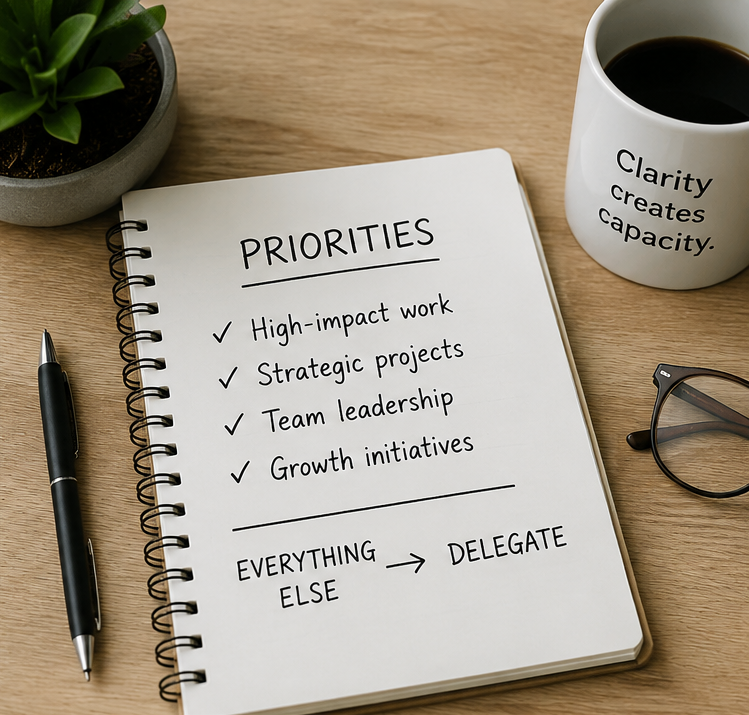 bigger conversation about her role as a whole.
Instead of framing the issue as: “I don’t want this work” the conversation becomes:
“Here is how my role has evolved. Here is what I am currently handling. Here are the priorities I believe are most important. Can we align together on what I should continue owning and where tradeoffs may need to happen?”
This is a very different kind of conversation. It helps the manager see the full picture instead of reacting to a single moment of pushback. It also creates an opportunity to make invisible growth visible.
A Final Thought
Many professionals think setting boundaries is simply about learning how to say no.
But in many workplaces, the more important skill is learning how to create alignment around priorities, ownership, and capacity before burnout quietly builds underneath the surface.
It is ultimately up to you to proactively manage your boss’s perception of your role and help them fully understand how your responsibilities have evolved over time.
This is also an opportunity to advocate for the parts of the expanded role that energize and grow you, while reaching mutual agreement to shift more routine or lower-value responsibilities elsewhere.
Strong performers often wait for managers to notice how much their role has changed. In reality, the people who navigate growth most successfully are usually the ones who help shape the conversation early, gaining both greater appreciation from their managers and more influence over the direction of their careers.
I am always in your corner 🙂
Lei