Have you ever walked out of a presentation you led thinking, “That was such a waste of time. I spent hours preparing, yet somehow what I had been asked to prepare wasn’t even what the senior leader wanted to discuss. Worst of all, I walked away with feedback that I needed to become a better presenter.”
If that sounds familiar, you’re not alone.
What’s even more frustrating is everything that happened before the meeting. You probably spent hours revising your deck after round after round of feedback: “Add this slide. Include more detail. No, simplify it. Move this section earlier.” By the time you walked into the room, the presentation barely felt like your own.
It’s easy to walk away from an experience like that believing you need better presentation skills. But what if that’s not the real problem?
Over the years, I’ve noticed something interesting. The people who struggle most with presentations are rarely struggling because they don’t know how to build slides. More often, they’re trying to answer the wrong question.
Instead of asking, “How do I make this presentation better?” they’re better served asking, “What outcome are we trying to create?”
The Mindset Shift
I saw this play out recently while coaching a product manager. She had been asked to prepare a presentation for a senior leader, and her manager wanted a polished slide deck.
She felt it was too early. Her team was still trying to align on the problem they were solving, and she worried that a polished presentation would shift the discussion toward debating features instead of having the strategic conversation they actually needed.
For the first time, she pushed back. Instead of building a full presentation, she proposed bringing a one-page discussion document. Her goal wasn’t to do less work. It was to create a better discussion so she could align with the senior leader on the problem before investing time polishing slides.
That was the moment she began to think differently. She was no longer asking, “What did they ask me to produce?” She was asking, “What outcome are we actually trying to achieve?”
At first glance, that sounds like a small change in wording. In reality, it’s a completely different way of approaching our work. As we grow in our careers, that shift becomes increasingly important.
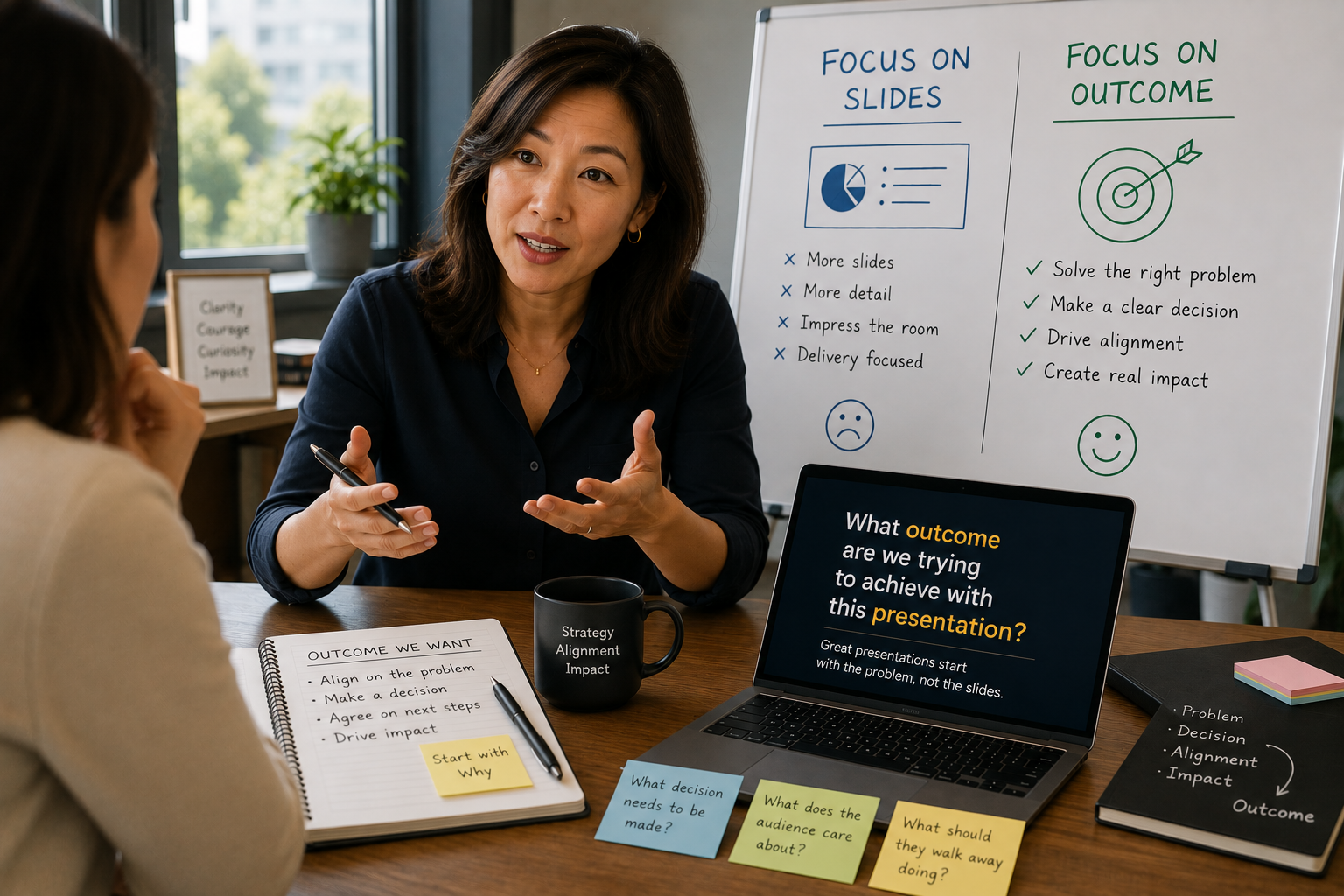
Focus on the Outcome, Not the Task
Early in our careers, we’re rewarded for executing well.
- Someone asks for a presentation, so we build the presentation.
- Someone asks for an analysis, so we complete the analysis.
- Someone asks for a report, so we write the report.
These are important skills, and they’re often what help us earn promotions early on. As we grow in our careers, something starts to change. People care less about how well we complete assignments and more about whether we’re helping our teams achieve the right outcome.
Instead of try to build slides immediately, it’s worth taking a step back and asking:
- What problem are we trying to solve?
- What decision needs to be made?
- What does this audience actually care about?
- What should people walk away understanding or doing differently?
Those answers should shape the deliverable, not the other way around. The presentation isn’t the goal. It’s simply one tool to help the team solve a problem or make a better decision.
This applies far beyond presentations. Whether we’re writing a proposal, leading a project, creating a marketing plan, or preparing for an important customer meeting, it’s easy to become so focused on completing the task that we lose sight of why we’re doing it in the first place.
Push Back with Curiosity
Thinking like an owner doesn’t mean resisting feedback. In fact, the best leaders actively seek it. The difference is that they don’t abandon their thinking the moment someone more senior has a different opinion.
Instead of saying, “I don’t think executives care about this,” try asking, “What decision are we hoping they’ll make after this meeting?” Or, “How does this help us achieve the outcome we’re looking for?”
Neither question challenges the person. They simply shift the conversation back to the outcome everyone is trying to achieve.
Instead of debating the task, we can get curious about the outcome. That simple shift changes the conversation from defending our work to improving it. We’re no longer just reacting to requests. We’re helping shape the discussion so the team can make better decisions.
Confidence Comes from Conviction
Many of us believe confidence comes from becoming a better presenter. I think it comes from something much deeper. Confidence comes from conviction.
When we understand the problem deeply, have a clear point of view, and know what outcome we’re trying to create, we stop trying to guess what everyone wants to hear. We start leading the discussion instead.
That doesn’t mean we’re always right. It means we’re bringing thoughtful judgment while remaining open to new information. Ironically, that’s what people often describe as executive presence. It’s not certainty. It’s conviction combined with curiosity.
The most confident leaders I’ve worked with weren’t the ones who had all the answers. They were the ones who had thought deeply about the problem, were willing to share their perspective, and were equally willing to change their minds when new information emerged.
The Ownership Mindset
Whether we’re preparing a presentation, leading a project or writing a proposal, the deliverable isn’t the work. The real work is solving meaningful problems. Presentations, reports, spreadsheets, project plans, and roadmaps are simply tools that help us get there.
The professionals who continue to grow are the ones who stop asking, “What do you want me to do?” and start asking, “What are we trying to accomplish?” It’s a subtle shift, but it’s one of the defining moments when someone moves from being an executor to becoming a leader.
The next time you’re asked to create a presentation, don’t start by asking what slides to build. Start by asking what outcome you’re trying to create. You may discover that you weren’t trying to become a better presenter after all. You were learning to become a better leader.
Best wishes to your career success
Lei