I’m now in the fifth week of what I confidently called a “four-week flare-up” in my earlier article, The Health Debt from Overwork. I laugh a little when I think about that now. Apparently, my body didn’t get the memo.
For the first three weeks, I was mostly in denial. I knew I was hurting, but I kept telling myself it was minor. I thought if I just cut back on my phone and computer, rested a little more, went to my chiropractor and acupuncture, it would pass.
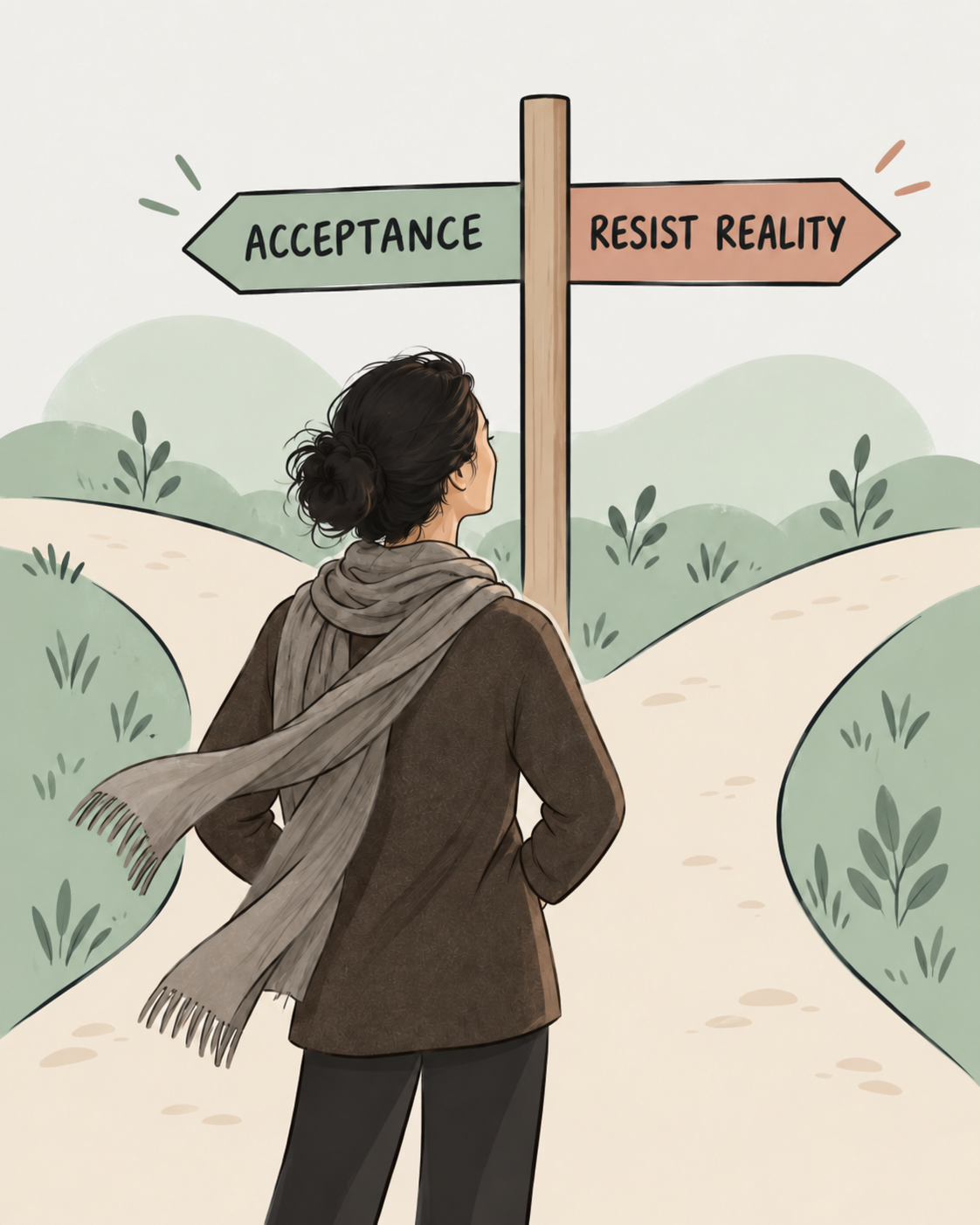 I wasn’t completely ignoring the problem. I was doing things to help myself. But underneath all of that, I was still negotiating with the situation. I told myself I was using my phone 90% less, but then I’d pick it up for ten minutes and the pain would come right back into my shoulders. I was in pain, but resisted taking much medication, almost as if taking the flare-up seriously would somehow make it more serious. I had just gotten into a good rhythm with weight training, and I was angry that I had to stop.
Mostly, I was waiting for the whole thing to be over. And the more I waited for it to be over, the more impatient I became.
The turning point came around week four, when we traveled to Irvine for my uncle’s funeral. We spent a lot of time in cold, air-conditioned rooms, and my muscles tightened badly. The pain in my back and arms got up to around a seven out of ten.
I talked to my cousin, who is a nurse, and she pointed out that I probably wasn’t treating the inflammation enough. Until then, I had been taking only one or two Advils a day, partly because I still wanted to believe this wasn’t a big deal.
That was when I finally stopped treating the flare-up like a nuisance I could simply wait out.
Acceptance Changed the Question I Was Asking
Something shifted once I stopped asking, “When is this going to be over?” and started asking, “Given that this is where I am right now, what do I actually need?” That question changed the way I approached the whole situation and the quality of the decisions I made.
I started taking recovery more seriously.
- I stopped repeatedly testing whether ten minutes on my phone might be okay.
- I used voice instead of typing.
- I asked my husband and daughter for help with things I normally would have done myself.
- I took the medication I had been advised to take.
- I walked, napped, danced (as cardio actually seems to help) and stopped giving my recovery a deadline.
I also had to let go of another assumption: that because I had recovered from a similar injury twenty years ago, I already knew what to do this time. I knew a lot about my old injury, but that didn’t mean my twenty-year-old knowledge about healing was enough for what was happening now.
That became especially clear when I went to see my physical therapist. I expected her to massage my back or shoulders, because that was where I felt the pain. Instead, she tested the range of motion in my neck and shoulders and worked on the front of my neck and chest area. Almost immediately, some of the tension released.
Once she explained it, it made sense. If I had been spending so much time leaning forward over a phone or computer, the muscles in the front of my body could be tightening and contributing to pain elsewhere.
I hadn’t thought of that. And I think that is part of what acceptance gave me: the ability to admit that I might not already know the answer.
Resistance Can Narrow Our Thinking
The more I resisted the situation, the narrower my thinking became. I decided what should be happening. I decided how long it should take. I assumed I knew what recovery should look like.
Once I accepted that this flare-up was real and that I didn’t know exactly how long it would last, my thinking opened up. I became more willing to listen, learn, and ask for help. And I’m realizing that this lesson is much bigger than this particular injury.
When something happens that we don’t want, I think our first instinct is often to resist it. We think, This shouldn’t be happening. This will be over soon. I can fix this quickly and get back to where I was.
Sometimes resistance is useful. It can motivate us to change what can still be changed. But sometimes the situation has already happened. We lost the job. The reorganization went through. We didn’t get the promotion. A relationship changed. A parent is aging. Our body is injured.
At that point, being angry, denying what happened, or continually wishing it were different doesn’t undo it. It can actually delay the moment when we become calm enough to think clearly about what might be possible now.
What Radical Acceptance Means to Me
This is what radical acceptance is starting to mean for me. It isn’t resignation. It isn’t giving up. And it definitely doesn’t mean liking what happened. It means acknowledging: This is the situation I am in right now.
From there, my thinking seems to open up. Instead of pouring energy into wishing reality were different, I can ask better questions: What do I need now? What am I not seeing? Who can help me? What options might exist that I couldn’t see while I was busy being angry, afraid, or trying to rush through this?
That has been the surprising lesson of these last few weeks. Acceptance didn’t make me passive. It made me more open-minded, more teachable, and more willing to ask for help. And because of that, I started making better decisions.
I’m Still in Week Five
I’m still in week five. I don’t know if there will be a week six or seven. I would still much rather be back to normal. I miss weight training. I miss being able to use my phone and computer without thinking about it. I miss sleeping without having to manage pain.
But I’m no longer standing at some imaginary finish line waiting for my body to hurry up and join me. I’m here. And from here, I can listen better, learn more, accept help, and make decisions based on what is actually happening instead of what I wish were happening.
Is there something difficult in your life right now that you’re still resisting? What might become possible if, just for a moment, you stopped arguing with the fact that it’s here?
I’d love to hear from you. Subscribe to my Substack and leave a comment there
I am always in your corner
Lei